Natural search engine optimization (SEO) is undergoing a continuous revolution driven by the evolution of ChatGPT, developed by OpenAI. Following the advances of GPT-4, the emergence of reasoning models like o1 and the integration of GPT-4o have redefined the standards. This powerful artificial intelligence tool generates high-quality content optimized for search engines and is now indispensable for GEO (Generative Engine Optimization).
Marketers, bloggers, and entrepreneurs must grasp ChatGPT's impact on SEO to stay ahead in the digital space in 2026. ChatGPT goes beyond simple automation. It acts as an intelligent assistant that boosts creativity, optimizes processes, and ensures exceptional content quality, freeing up time for SEO content strategy and complex data analysis.
Thanks to its ability to create content aligned with user queries and to incorporate semantic keywords, ChatGPT is a valuable ally for improving visibility on Google and new answer engines like SearchGPT. This article will help you leverage ChatGPT to supercharge your SEO strategy in 2026.
Understanding ChatGPT's Capabilities for SEO
What Is ChatGPT?
ChatGPT is a language prediction model developed by OpenAI. In 2026, it no longer simply predicts the next word — it reasons to provide structured, factual responses. This AI can produce text that perfectly mimics human language, making it indispensable for modern SEO.
What Makes ChatGPT Distinctive
ChatGPT stands out for its ability to actively participate in discussions and handle increasingly long contexts. It helps discover new keywords, generate article ideas, and above all, adapt content to the conversational search intents that dominate today's market.
The Nature and Evolution of ChatGPT
ChatGPT's evolution toward more advanced reasoning models has transformed the tool into a genuine strategic partner for SEO. This innovation marks a notable step toward an intelligent assistant capable of enriching human creativity by structuring more factual, precise, and nuanced responses.
Its ability to understand natural language has become key to satisfying Google's criteria, which now prioritizes user experience and information reliability through the E-E-A-T framework. In 2026, ChatGPT doesn't just write — it allows you to align content precisely with the needs of new answer engines while maintaining the qualitative approach that is essential to standing out from the competition.
Practical Uses of ChatGPT in SEO
ChatGPT offers multiple practical applications to revolutionize your SEO strategy in 2026. Among these, proper keyword integration and semantic clustering stand out. ChatGPT can help generate and organize a complex keyword list, making it easier to research and naturally incorporate long-tail terms or conversational queries into your content.
This avoids keyword stuffing while ensuring their use is relevant to both traditional search engines and new AI-powered answer engines, improving readability and the chances of ranking well.
In addition, ChatGPT proves valuable for structuring content in an e-commerce SEO project. It can create optimized titles and meta descriptions to maximize click-through rates, as well as clear headings and subheadings, improving crawling for indexing bots and the user experience.
A smooth reading experience and a well-thought-out information hierarchy are essential for improving reader engagement and boosting SEO rankings. Logically generated internal and external link recommendations also help strengthen the site's semantic authority.
ChatGPT also plays an essential role in keyword research and in-depth analysis of search intent. It can identify high-potential key phrases, evaluate competition in real time, and pinpoint terms that perfectly match users' specific needs.
In 2026, this analytical capability allows for more surgical traffic targeting and higher conversion rates by responding precisely to the audience's pain points.
Furthermore, ChatGPT can handle repetitive and technical SEO tasks such as generating structured data, creating XML sitemaps, managing meta tags, and even evaluating website performance from raw data. This frees up time for more complex strategic and analytical activities, enabling rapid adaptation to emerging trends and the increasingly frequent algorithmic updates from search engines.
{{audit-primary="/cta"}}
Advanced Strategies for Integrating ChatGPT into Your SEO in 2026
Optimizing AI-Generated Content
Integrating ChatGPT into your SEO content strategy by optimizing AI-assisted production is an extremely effective method in 2026. Thanks to its ability to instantly process massive data streams, ChatGPT identifies semantic entities and current search trends with surgical precision. This speed of analysis allows you to seize positioning opportunities in real time and adjust your editorial approach to better meet algorithmic expectations.
ChatGPT ensures the smooth insertion of targeted terms, eliminating any risk of over-optimization while increasing readability and chances of visibility in answer engines. It also contributes to content hierarchization by proposing optimized structures and markup, facilitating bot crawling and enriching the user experience. Prompt optimization now makes it possible to elevate content quality by integrating the nuances of GEO and guiding creation through very fine contextual instructions.
Moreover, AI generates a vast quantity of high-performing texts — from product pages to expert tips — while guaranteeing consistency of tone and quality. This capability has become vital for maintaining a coherent and competitive digital presence.
{{rdv-primary="/cta"}}
SEO Prompt Optimization
Precise prompt control is crucial for obtaining high-quality results with ChatGPT in 2026. It is now essential to define the search intent, data sources, and reasoning parameters to refine each output.
Prompts must incorporate the latest Search developments to steer the chatbot toward creating content that perfectly aligns with your goals. By structuring advanced instructions, you maximize ChatGPT's impact in producing pages optimized for hybrid search environments.
Here are some example prompts you can give to ChatGPT to advance your SEO strategy in 2026:
ChatGPT Prompt #1: Keyword Research
"Act as an SEO expert. Help me find topic ideas by creating a table of transactional and informational keywords for the subject: [my topic].
I want the table organized as follows:
Column 1: Keyword cluster
Column 2: Search intent
Column 3: Keyword
Column 4: Type of content to create (commercial page or blog post)
Column 5: Example title tag
Column 6: Example meta description tag"
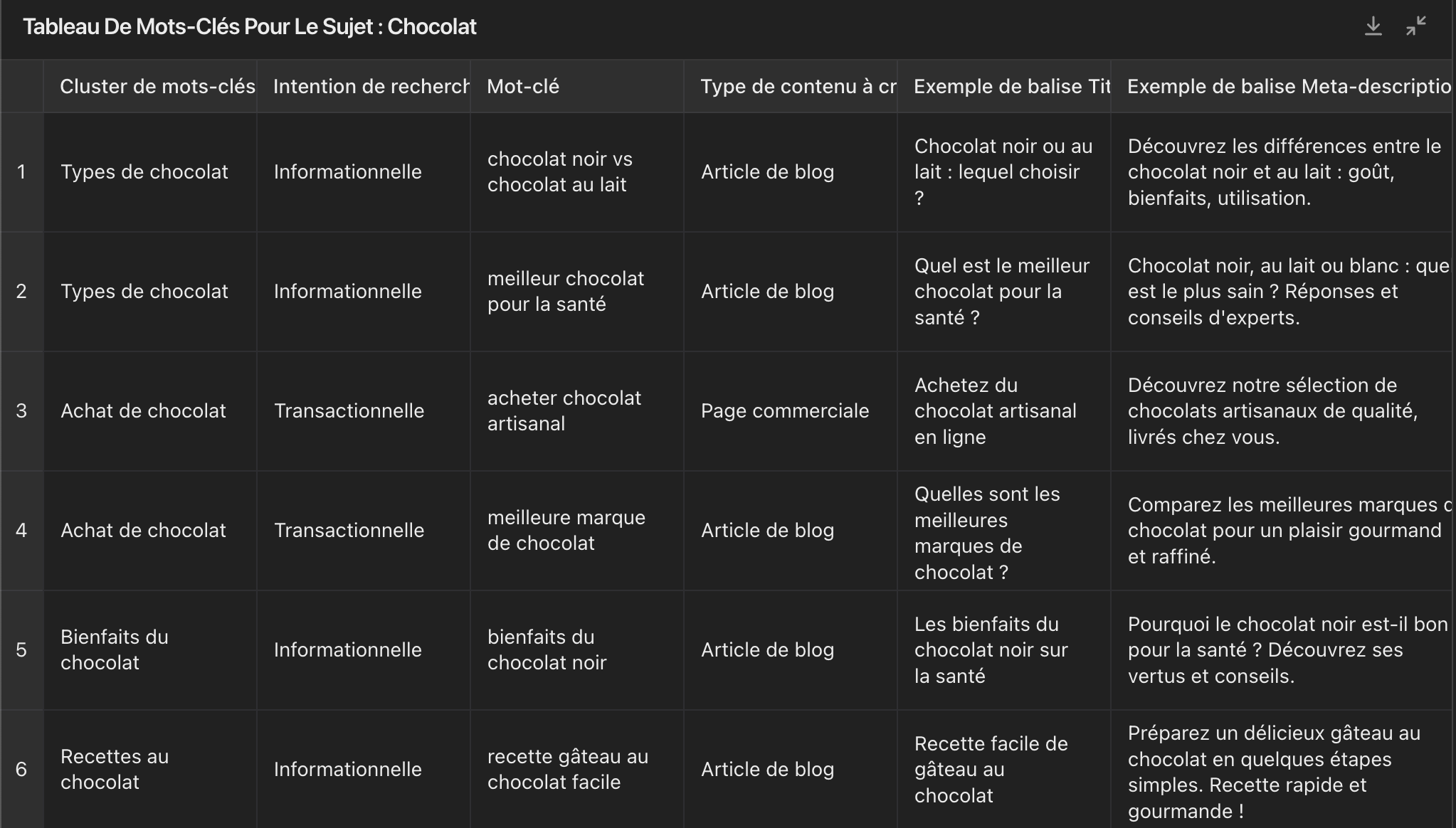
This prompt is an excellent way to leverage ChatGPT for structured and actionable keyword research. It delivers a detailed table that facilitates query segmentation based on search intent (transactional or informational). By specifying the type of content to create, it helps optimize your editorial strategy, clearly distinguishing between commercial pages and blog posts. In addition, generating examples of title tags and meta descriptions ensures a directly usable SEO approach, minimizing manual adjustments. This type of prompt transforms a simple brainstorm into a concrete, optimized action plan for improving organic search rankings.
Here is an example of what you could get using this prompt.
ChatGPT Prompt #2: Optimizing a Blog Post for SEO
"Act as an SEO expert. Help me optimize this article for organic search. Analyze and fix the following points:
- Here is my primary keyword: [my topic]
- Here are the secondary keywords I'm targeting: [topic 1] / [topic 2] / [topic 3]...
- Add and optimize keyword occurrences while maintaining natural integration
- Improve structure using H1, H2, and H3 title tags
- Propose an attractive, optimized SEO title (35-62 characters)
- Write an engaging meta description (135-155 characters)
- Add suggestions for relevant internal and external links
Here is my article: [paste text here]"
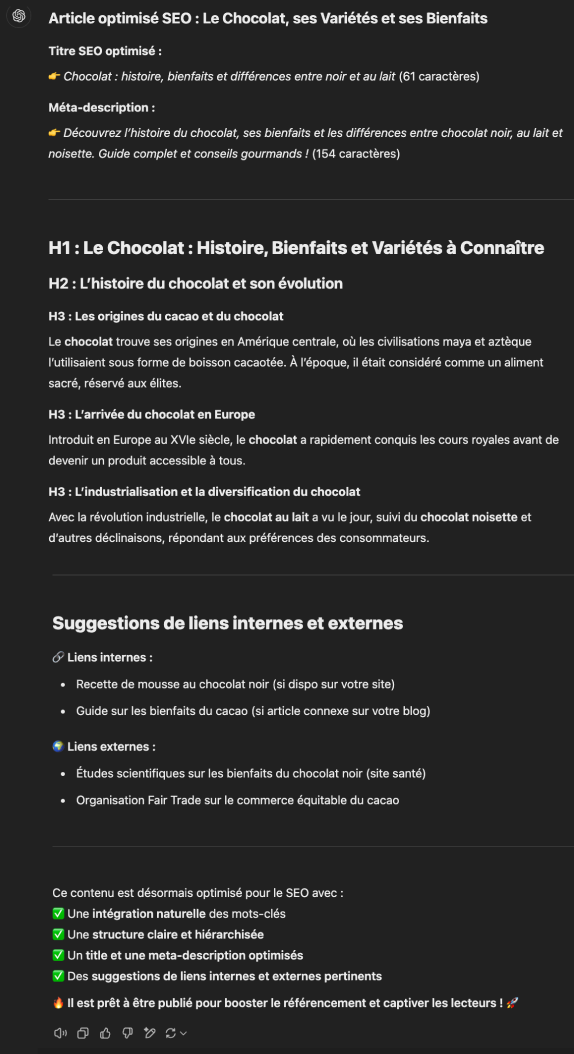
This prompt improves existing content by applying SEO best practices while preserving readability and a natural tone. It provides comprehensive optimization by incorporating strategic keywords, a better structure through relevant heading tags, and high-performing SEO tag writing. By including recommendations on internal and external linking, it also helps strengthen the page's authority. The result: content that is better ranked on Google and more engaging for readers.
Here is an example of what you could get using this prompt.
ChatGPT Prompt #3: Creating an SEO Brief for a Writer
"Act as an SEO expert and help me create a detailed brief for a web writer. This brief should include:
- The article topic: [specify the topic]
- The primary and secondary search intent
- The primary keyword targeted
- A shortlist of secondary keywords
- An optimized structure with H1, H2, H3 headings, along with a proposed title tag and meta description
- A recommended tone and writing style
- Recommendations on text length and density
- Ideas for internal and external links to include
Generate this brief in a clear, structured format, ready to be sent to a writer."
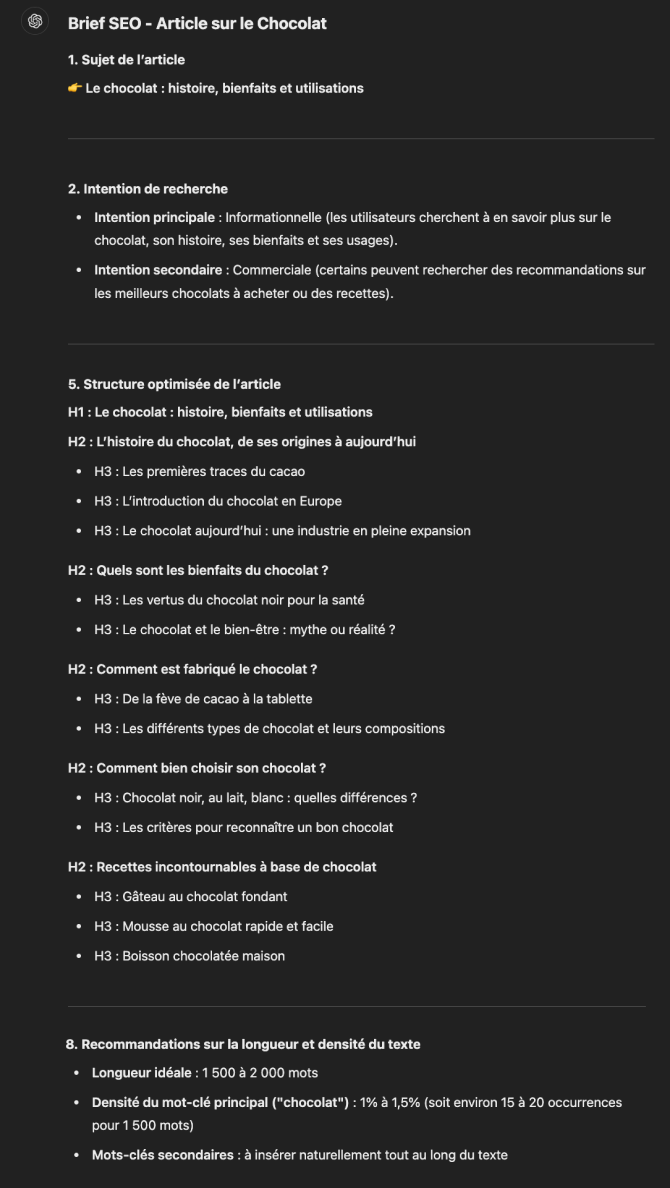
This prompt facilitates the transmission of a clear, precise framework to a writer, ensuring SEO consistency from the outset. By defining the search intent, the keywords to incorporate, and the recommended structure, it eliminates ambiguity and ensures high-performing content from publication. Adding recommendations on tone, length, and internal links optimizes not only search rankings but also the user experience. It's a major time-saver for SEO and editorial teams, who can produce effective content faster.
Here is an example of what you could get using this prompt.
Advanced ChatGPT Customization
ChatGPT is a versatile tool capable of assisting in content creation across a variety of platforms and objectives. To create content that is both effective and SEO-friendly, it's essential to customize prompts based on the specific needs of your business. Prompts can include keywords related to your niche, examples of real content, or advanced parameters to refine the request. This customization produces content that not only meets search engine requirements but also captivates and engages your target audience.
{{expert-primary="/cta"}}
Avoiding the Pitfalls of AI-Generated Content
While ChatGPT offers numerous advantages, it's essential to avoid certain practices in order to fully leverage its potential without compromising the quality and credibility of your content. First and foremost, never try to manipulate Google's search algorithms.
Content produced by AI should aim to enhance the quality and relevance of the content offered, rather than attempting to game search engines.
It is also critical not to compromise content quality. A thorough review of AI-generated content is necessary to avoid errors, inconsistencies, and misleading or inaccurate information. A drop in quality could affect your credibility, reduce your online visibility, and lead to legal consequences. It is equally important to create content optimized for social media in order to maximize engagement and reach on those platforms.
Finally, it is essential to follow Google's guidelines and adopt a responsible use of AI in content creation, since using ChatGPT for SEO presents a major risk when misused — particularly with regard to Google's E-E-A-T criteria (Experience, Expertise, Authority, Trustworthiness). Automatically generated content often lacks genuine human expertise and can be perceived as superficial, which undermines its credibility in the eyes of search engines.
Google, increasingly demanding in terms of content quality and authenticity, penalizes abusive practices such as generating text without real human involvement. Far from being a magic solution, ChatGPT should be an assistance tool rather than a replacement for editorial work, or risk seeing your rankings drop in the long run.
ChatGPT's Role in the Future Evolution of SEO
ChatGPT is revolutionizing SEO by integrating artificial intelligence into organic search strategies. It plays a diverse and significant role in the future of SEO. First, thanks to its predictive analytics capability, ChatGPT can anticipate upcoming search trends, allowing SEO experts to effectively position themselves on topics and content formats set to gain popularity. This ensures continuous visibility and engagement.
In addition, using ChatGPT is essential for optimizing for AI-based search engines like Google Gemini. These search engines evaluate user intent with great sophistication. ChatGPT helps create content that responds precisely and contextually to these intents. It guides AI engines toward the most relevant answers and creates content that addresses both explicit queries and potential implicit questions from users.
ChatGPT also improves content personalization based on user preferences and behaviors. Thanks to its natural language processing capabilities, it generates dynamic content tailored to the specific needs of visitors, improving the user experience and increasing engagement rates.
Preparing for Future Algorithm Updates
Search algorithm updates, such as the August 2024 Core Update, highlight the importance of a proactive approach to SEO changes. To anticipate the impact of these updates, businesses must stay informed about Google's trends and announcements regarding algorithmic adjustments.
ChatGPT plays a key role in analyzing these trends and adapting content strategies. It is essential to maintain a flexible and adaptable content strategy, with the expertise of an SEO consultant. ChatGPT assists in creating content optimized for current algorithms while preparing for future evolutions. This includes using structured data (Schema.org) to help AI interpret content and technical site optimization to improve loading speeds and correct markup errors.
Finally, SEO experts must prepare for the challenges of hybrid SEO, dominated by AI search engines. This requires a deep understanding of new algorithms and strategies to maintain visibility in a landscape where AI-generated responses are becoming the norm.
Limitations and Precautions
ChatGPT Is Not Infallible
ChatGPT is not infallible. Although it is powerful, its responses must be verified and nuanced. It is crucial to remain vigilant about the accuracy of the information provided. Google can detect content generated without human added value and downrank it. To avoid this, always bring human expertise to ensure the accuracy and relevance of every publication.
Conclusion
In conclusion, ChatGPT is revolutionizing SEO in 2026 through its combination of efficiency and artificial intelligence. This technology creates high-quality content aligned with user intent. Its strengths include seamless keyword integration, coherent organization, and tag optimization to boost overall visibility.
ChatGPT also facilitates the automation of repetitive tasks and trend prediction, freeing up experts for more sophisticated analyses. It remains essential to pair these capabilities with human proofreading to ensure the accuracy of the content produced.
Integrating ChatGPT into your strategy without delay will keep you competitive in a rapidly changing digital landscape. By adopting these methods, you will improve your rankings, increase engagement, and guarantee a dominant online presence.
Want expert guidance on your digital marketing strategy? Feel free to reach out!
FAQ
How Can ChatGPT Improve SEO Data Analysis?
ChatGPT can significantly improve SEO data analysis in several ways:
- Identifying trends and gaps: ChatGPT can analyze large datasets from tools such as Google Search Console and Google Analytics to identify emerging trends, uncover gaps, and detect technical issues in your SEO strategy.
- Keyword research and optimization: ChatGPT excels at keyword research, suggesting high-potential keywords including long-tail phrases, and ensuring these keywords are contextually relevant to the content, thereby improving search quality.
- Content creation and optimization: ChatGPT can generate SEO-compatible content, including articles, blog posts, and product descriptions that resonate with target audiences. It also helps optimize meta titles, descriptions, and URLs to improve search engine visibility.
- Search traffic and user behavior analysis: By analyzing search traffic data, ChatGPT can help monitor search traffic trends, identify peak hours, days of the week, and device usage, providing valuable insights into user behavior.
- Identifying SEO opportunities: ChatGPT can uncover new SEO opportunities by analyzing data from different sections of Google Search Console, such as Performance, Pages, Links, and Indexing, helping refine SEO strategy and stay ahead of the competition.
- Report and insight generation: ChatGPT can automate the creation of comprehensive reports and actionable insights, enabling data-driven decisions and streamlining the SEO workflow.
What Are the Benefits of Using ChatGPT for Keyword Research and Content Optimization?
Using ChatGPT for keyword research and content optimization offers multiple benefits:
- ChatGPT can generate high-quality, search engine-optimized content by naturally integrating essential keywords and key phrases.
- It helps identify search trends and suggest relevant keywords, enhancing the relevance of content for specific queries.
- In addition, ChatGPT accelerates content creation, maintains consistency and quality, and enables the creation of engaging content for users, improving click-through rates and reducing bounce rates.
How Can ChatGPT Help Optimize Content for Voice Search and Conversational Queries?
ChatGPT can help optimize content for voice search and conversational queries in several ways:
- Generating natural and conversational content: ChatGPT can create content that mimics users' natural language, which is essential for voice searches.
- Keyword research: ChatGPT can identify relevant keyword lists, including long-tail keywords, tailored to voice search queries.
- Content structuring: It can structure content using headings, bullet points, and numbered lists, making the content more readable and accessible to voice assistant users.
- Personalization and context: ChatGPT can incorporate personalization and contextual elements, improving the user experience and the relevance of responses for voice assistant users.
How Does ChatGPT Affect Zero-Click Searches and How Can You Adapt to This Trend?
ChatGPT can significantly impact zero-click searches by providing direct and detailed answers to user questions, reducing the need to click on search links. To adapt to this trend, content creators must focus on creating high-quality content that adds unique and original value that cannot be replicated by chatbots. This includes in-depth analyses, personal perspectives, and exclusive information that encourage users to explore further.