Do you want to improve the relevance of your Google Ads and increase your click-through rate (CTR)? Are you looking for ways to create personalized ads that precisely match what your prospects are searching for? Have you heard of keyword insertion but aren't sure how to get the most out of it?
This article is here to help. We'll break down what keyword insertion involves, how to implement it in Google Ads, and how to optimize it for the best results. Keyword insertion is a sophisticated Google Ads feature that automatically incorporates keywords from your ad group directly into your ad copy. This makes your ads more relevant and appealing to users who are interested in what you offer.
Using keyword insertion can not only improve your quality score and your conversion rate, but also lower your cost per acquisition (CPA). It also saves time and ad spend by eliminating the need to manually create separate ads for each keyword. That said, this technique requires thoughtful application and adherence to best practices to avoid potentially costly mistakes.
In the rest of this article, we'll guide you step by step through setting up keyword insertion in Google Ads and share tips to optimize your use of this tool. Whether you're a beginner or a Google Ads expert, you'll find valuable insights to supercharge your campaigns with keyword insertion.
Keyword Insertion in Google Ads: The Basics
What is keyword insertion?
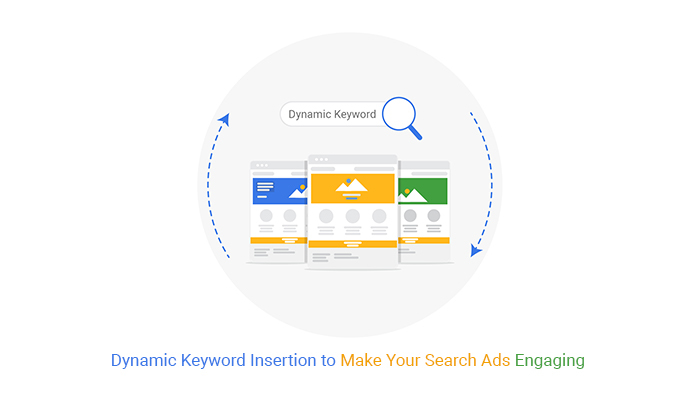
Keyword insertion is an advanced Google Ads technique that enables the automatic addition of keywords from your ad group into your ads. This ensures your ads are directly aligned with what users are looking for.
For example, if your ad group contains the keywords "athletic shoes," "sneakers," "trainers," you can place the code {KeyWord:Athletic Shoes} in your ad headline. Google Ads will automatically replace this code with the keyword that triggered your ad, respecting capitalization rules and character limits. If the keyword is too long or not in your ad group, Google Ads will use the default text "Athletic Shoes."
The benefits of personalizing your ads with keyword insertion
Keyword insertion offers several significant advantages for your Google Ads campaigns:
- It ensures a boost in the relevance of your ads, tailoring them to user queries.
- It contributes to improving your click-through rate (CTR) by making your ads more attractive and eye-catching.
- It supports a better quality score by lowering bounce rates and increasing time spent on your site.
- It helps grow your conversion rate by driving more qualified traffic to your landing page.
- It offers time and cost savings by eliminating the need to create multiple ads for each keyword.
Typical use cases for dynamic keyword insertion
Keyword insertion applies in a variety of contexts, adapted to your marketing goals and strategies:
Used strategically, keyword insertion can turn your ad campaigns into standout successes. Here are a few tips to make the most of it:
- Diversify your ads based on your range of products or services by creating specific ads for each category using keyword insertion.
- For targeted messaging, tailor your ads to different geographic areas by including the city or country name with keyword insertion.
- If your brand offers promotional deals or stands out through competitive pricing, highlight these advantages over your competitors using keyword insertion.
Step-by-Step Guide to Setting Up Keyword Insertion
Preparing your ad groups for keyword insertion
Make sure your ad groups are well structured, with relevant and consistent keywords, before creating your ads. Group your ads by theme or product/service category, incorporating appropriate keywords.
For example, for athletic shoes, consider separate groups for running shoes or fitness shoes. Long-tail keywords are also valuable for attracting higher-quality traffic thanks to their specificity and lower competition.
Creating an ad with keyword insertion
To write an ad that includes keyword insertion, use the specific syntax: {KeyWord:Default Text}. The "Default Text" will be displayed if there is an issue with the selected keyword. You can adjust the capitalization of the keyword using the following variants: KeyWord, Keyword, keyword, or KEYWORD. The choice depends on the visual impact you want in your ad.
Tips for writing flexible and relevant ads
- Always check grammatical and stylistic consistency after keyword insertion.
- Choose default text that fits your ad group's theme and drives action.
- Experiment with different ad variations incorporating keywords and analyze their performance.
- Use negative keywords to filter out irrelevant queries from your targeting.
Managing keyword insertion variants and options
Google Ads may show different variants of your keywords, such as synonyms or plurals. You can control the level of match between these variants and your keywords by choosing the right match type: exact, broad, modified, or phrase. You can also decide whether to enable close variants, which allows your ads to appear for queries that are very similar to your keywords, even if they are not identical.
Explore the potential of keyword insertion options to personalize your ads. Incorporate information such as price, availability, or location using dynamic tags like {param1}, {param2}, {param3}. Additionally, improve the user experience by displaying device-specific content with {ifmobile:Mobile Text} and {ifnotmobile:Non-mobile Text}.
Optimization and Best Practices for Keyword Insertion
Analyzing and measuring the effectiveness of your personalized ads
To optimize your Google Ads campaigns, it's essential to analyze and measure the performance of your personalized ads. Use Google Ads performance reports to track key metrics such as impressions, click-through rate (CTR), cost per click (CPC), conversion rate, and return on investment (ROI). Segment your data by keyword, device type, or geographic location to identify trends and areas for improvement. Google Ads testing and experimentation tools also allow you to compare different ad versions and use the performance planner to anticipate the impact of your adjustments.
Advanced strategies and tips to maximize your ads' potential
Maximize your ads' potential by applying advanced strategies:
- Enrich your ads with extensions that provide more detail, such as customer reviews, and use keyword insertion for deeper personalization.
- Adapt your ads to different formats and devices with responsive ads, incorporating relevant keywords.
- Optimize your bids using smart bidding strategies and improve ad relevance for better results.
- Automate keyword insertion management with Google Ads scripts for greater efficiency and custom reporting.
Conclusion
Keyword insertion is an advanced Google Ads feature that allows you to personalize your ads based on what users are searching for. It's key to improving the relevance, appeal, and performance of your ads, and to maximizing your return on investment. That said, this technique should be used with care, following best practices to avoid mistakes and potential pitfalls.
In this article, we covered keyword insertion in depth, how to configure it in Google Ads, and best practices for optimizing your results. We provided practical examples, tips for writing effective ads, and advanced tactics to fully unlock the potential of your ad campaigns.
With this information, you now have the tools you need to incorporate keyword insertion into your Google Ads strategies. It's time to take action and build truly tailored ads!
Want support with your digital marketing strategy? Feel free to get in touch!
FAQs
Q: How do you use keyword insertion in your ads?
A: Keyword insertion is an advanced technique that allows you to personalize your ad content based on the search terms entered by your prospects. This increases the relevance of your ads to people searching for exactly what you offer. For example, if you manage a chocolate shop, you can insert a keyword insertion code in the headline of your ad such as: {KeyWord:Chocolate}. Google Ads will replace this code with one of your specific keywords, like "dark chocolate," "sugar-free chocolate," or "gourmet chocolate truffles," and if that's not possible, it will simply use the term "Chocolate."
Q: How do you add keywords in Google Ads?
A: To add keywords to Google Ads, follow these steps:
- Sign in to your Google Ads account and select the Campaigns tab.
- Go to the "Audiences, keywords, and content" dropdown menu.
- Choose the Search keywords option.
- Click the "Plus" button.
- Select the ad group you want to add keywords to.
- Click "+ Add a keyword."
- Type your keyword or phrase and select the appropriate match type.
- Confirm with the relevant symbol. For more guidance, you can refer to the [Add keywords - Google Ads Help] article.
Q: How do you add an exact match keyword in Google Ads?
A: To add an exact match keyword to your Google Ads campaigns, wrap your term in square brackets, like [women's hats]. This method ensures your ads only show when the user's search matches or is very close to your term. Google Ads' keyword planner is a great way to discover exact match keywords suited to your industry. To learn more, you can explore the following resources: [Exact match keyword in Google Ads: how to use it to boost your conversions?], [Add a keyword - Google Ads Editor Help], [Add keywords - Google Ads Help], [Configure the keyword insertion tool - Google Help].
Q: How do you add a large number of keywords at once in Google Ads?
A: Bulk-adding keywords to Google Ads is made easier with Google Ads Editor, a free downloadable application for simplified account management. The process is straightforward: load your account, make your changes, and upload your updates once done. The keyword planner is also useful for identifying relevant keywords and estimating their projected performance.