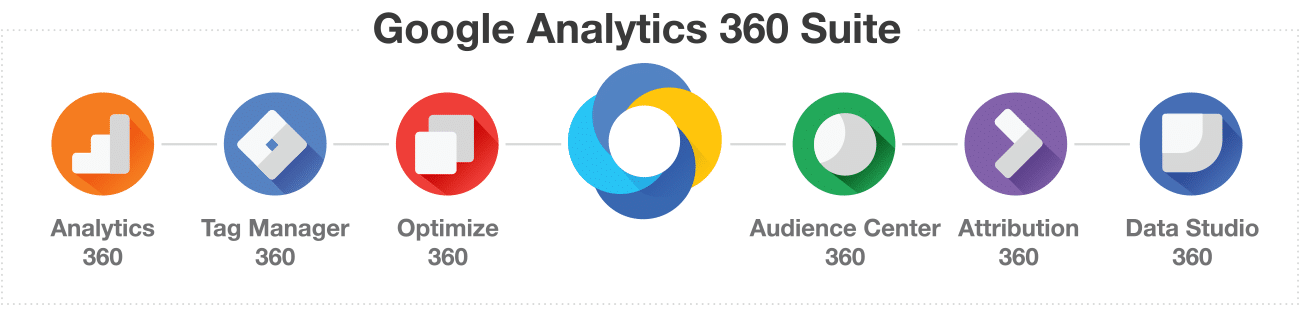
Google Analytics lets you collect and analyze information about your website visitors. This type of tool is a genuine necessity, and Analytics in particular is the most widely used audience analysis tool in the world (used by approximately 29 billion websites). Google offers a standard version and a paid version. What are the differences between standard Google Analytics and Google Analytics 360 (the paid version), and which one should you choose?
To help you see things more clearly and understand the differences so you can make the right choice, here are the advantages of GA 360 compared to the standard version.
Data volume and organization
The difference between Google Analytics and Google Analytics 360 is mainly about the volume of data collected: with the standard version, you can collect a maximum of 10 million "hits" per month, versus up to 1 billion with the 360 version. A hit corresponds to any user-side event, such as a page view, a button click, and so on.
The other major difference with Google Analytics 360 is the ability to manage more properties and more views, which makes it easier to organize collected data. You can also include more custom dimensions and metrics, which is significant for fully customized tracking.
Especially useful for large companies that manage multiple websites, the 360 version gives you the ability to create "Roll-up Properties." Roll-up Properties allow you to combine data from multiple properties into a single property.
Data import and integration
With Google Analytics, it is possible to send and receive data to and from certain advertising platforms, such as Google Ads. You can receive acquisition data from Google Ads, for example, and Google Analytics lets you export remarketing audiences to the advertising platform.
One of the distinctive features of Google Analytics Premium is its integration with DoubleClick Campaign Manager (formerly DoubleClick for Advertisers), DoubleClick Bid Manager, and DoubleClick for Publishers.
With the standard version of Google Analytics, it is also possible to import data from custom data sources, notably through the Data Layer, which lets you collect the information you want, such as clicks, page views, products, and more. The one limitation is that historical data cannot be viewed. Thanks to the "query-time import" feature, Google Analytics 360 allows you to import historical data as well as newly imported data directly from the interface.
APIs and Google BigQuery
A wide variety of APIs is available with Google Analytics for reporting or configuration purposes. Here, the main difference between the standard and paid versions again comes down to the volume of data that can be retrieved and analyzed. This feature is aimed at large enterprises that potentially manage multiple websites, as they can map their customer journey, analyze behavior from one session to the next, and aggregate data from various external sources.
Another major advantage of Analytics Premium is Google BigQuery. Google BigQuery is essentially a data warehouse designed to allow companies to run SQL queries very quickly, powered by Google's cloud processing capabilities. BigQuery is therefore a cloud service. This feature was built for Big Data, to enable the analysis of billions of rows of data.
In practice, this allows you to run deeper analyses and export more granular data from GA to Google BigQuery. This data warehouse is a very powerful tool for companies that want to fully understand their customers: their behavior, their journey, and more.
Reporting
Thanks to the data volume reaching 1 billion hits and the ability to import data from external sources, reports can contain significantly more data than in the standard version.
But the biggest advantage of 360 when it comes to reporting is its attribution models. In the free version of GA, you can set the attribution model for conversion values across the different channels involved in the conversion funnel. However, it can sometimes be difficult to determine the right attribution model (last-click, first-click, linear, etc.). Google Analytics 360 offers an algorithm based on your account's actual data to create a custom attribution model. On top of that, the paid version includes multi-channel conversion reports that are not available in the standard version.
Finally, Google Analytics 360 enables more detailed analysis of conversion paths through its many options and richer reports on conversion funnel analysis.
Sampling
As mentioned above, Google Analytics 360 allows you to collect up to 1 billion hits per month. Sampling thresholds are also higher, since 100 million sessions can be counted at the view level, compared to 500,000 for the free version. This advantage is once again aimed at large websites that generate substantial traffic. And as you have probably guessed, the 100-million-session sampling takes place at the view level, unlike the standard version where sampling occurs at the property level. You no longer need to add views within a single property in order to run more precise analyses.
In addition, Analytics 360 offers custom tables and unsampled reports to work with raw data rather than a subset of data that represents significant information.
Customer support
The final advantage of GA 360 lies in its customer support and level of assistance. With this version, you get access to 24/7 support. Through a commercial and technical assessment, the support team also offers guidance to help verify your project's implementation, perform quality checks, provide training, and more.
In summary
In summary, Google Analytics 360 lets you handle larger data volumes and access more advanced, customizable reporting dashboards. These are the biggest differences from the standard version. If you have one or more websites generating high traffic and you need to run deeper, more precise analyses, GA 360 is the right choice. On the other hand, if your hit count does not exceed 1 billion per month or if you only manage one website, the paid version is not essential.
Even though GA 360 provides exclusive features such as support, sampling, reporting, and more, they are not strictly necessary. The paid version is recommended when it makes sense for your business: if you have a large volume of data to process, if you need to carry out in-depth analyses, and if you require technical assistance. Otherwise, GA 360 is not necessary, especially since this version costs $150,000, or around €110,000 per year.
Want to analyze your website audience? Looking for support with your digital marketing strategy?