Google Ads offers a unique opportunity to promote your products and services. It lets you run ads across a wide range of platforms such as Google's search engine, websites, mobile apps, and partner video content. Using Google Ads means having access to millions of potential customers, boosting your visibility, growing your traffic, and of course, increasing your conversions and sales.
But faced with the available options, knowing which campaign type to choose based on your marketing objectives can be challenging. You may be wondering about the specific features and benefits of Search, Display, Video, App, Shopping, and Performance Max campaigns. What are their precise purposes?
This article serves as a guide for navigating the different campaign types available on Google Ads. We'll help you understand the specifics of each one so you can choose the option that best fits your product or service, your budget, and your target audience.
Search Campaigns: Reaching Users at the Moment of Search
Search campaigns give you the ability to place text ads directly on Google's Search Network, which includes not only the search engine itself but also its partner sites. With these campaigns, you precisely target users looking for specific products, services, information, or solutions, at the exact moment they express their need.
Campaigns on the Google Search Network
The Google Search Network is a massive advertising platform processing billions of daily searches. By displaying your ads there, you leverage the reach and power of Google to connect with prospects at the precise moment they show interest in your offerings.
Text Ads in Search Results
The most common Search campaign format comes in the form of text ads. These consist of a compelling headline, a concise description, and a targeted URL. They appear in search results, placed above or below organic listings depending on the quality and relevance of your ad. Text ads are an efficient way to make your promotional messages stand out and showcase your offers.
Ad Extensions to Improve Performance
To boost the effectiveness of your text ads, you can add ad extensions, which are options that enrich your content and catch the eye. These extensions can include call-to-action buttons, location information, compelling callouts, pricing details, and more. Adding extensions to your text ads is an effective strategy for optimizing your performance: it translates into an increase in click-through rate, web traffic, and ultimately, conversions.
Display Campaigns: Increasing Visibility with a Broad Audience
Display campaigns are an essential lever for strengthening your brand's online visibility. By using the Google Display Network, you reach millions of internet users across a variety of platforms, including websites, mobile apps, and Google properties such as YouTube and Gmail. This strategy is ideal for building brand awareness, attracting new customers, and strengthening relationships with your existing customer base.
Visual Ads on the Google Display Network
Display ads are visual creatives, static or animated, combined with elements such as text, a logo, or a call-to-action button. They are designed to adapt perfectly to users' screen sizes and formats. These ads are particularly effective at capturing internet users' attention and encouraging them to click, whether to explore your website, purchase your products or services, or engage with your brand.
Audience and Content Targeting
Audience and content targeting gives you the ability to precisely select the individuals and sites where your ads will appear. You can target users based on their interests, habits, demographic information, and more. You can also target websites based on their topic, category, keywords, and other criteria. This type of targeting ensures that your ads reach the individuals most likely to be interested in your brand, thereby optimizing the return on investment (ROI) of your ad campaigns.
Remarketing Campaigns to Reach Previous Visitors
Remarketing campaigns are specifically designed to reconnect with internet users who have already visited your website or used your app. This technique allows you to remind these visitors of your offer, inform them about your promotions, suggest additional products, and ultimately encourage them to return. By running remarketing campaigns, you can significantly increase your conversion rate and strengthen customer loyalty.
Video Campaigns: Captivating Audiences with Dynamic Content
Video campaigns offer the ability to show your ads on YouTube and the Google Display Network, allowing you to engage your audience with content that combines visuals and audio. This dynamic format is a powerful driver for strengthening your brand, increasing engagement, and driving conversions.
Presence on YouTube and Beyond
With more than 2 billion monthly active users, YouTube dominates the online video platform space. By running your ads there, you leverage the influence and reach of this channel to connect with an audience specifically interested in your field, your products, or your services. However, your presence is not limited to YouTube. The Google Display Network gives you an expanded audience across millions of partner websites and apps, letting you reach your prospects wherever they spend the most time.
Various Video Ad Formats
Several video ad formats are available to you, suited to different objectives and budgets. Choose skippable ads, which can be skipped after 5 seconds, or non-skippable ads, ensuring complete viewing. Bumper ads are short 6-second messages designed to grab attention quickly, while out-stream ads play automatically as users scroll through a web page or app. Choosing the right format means weighing visibility, user engagement, and cost to find the perfect balance for your brand.
Specific Targeting Strategies for Video
The success of your video campaigns depends on a high-performing targeting strategy. It allows you to show your ads to the individuals most likely to be interested in your offer. Refine your targeting using a variety of criteria, such as demographic information, interests, purchase intent, keywords, or specific placements. Remarketing is also a smart strategy for showing personalized ads to users who have already engaged with your website, app, or YouTube channel. Precise targeting is essential for optimizing the performance of your campaigns and measuring their impact on your key performance indicators.
App Campaigns: Promoting Mobile Applications
App campaigns are your go-to tool for increasing the visibility and engagement of your mobile applications. By leveraging Google platforms such as the Play Store, the search engine, YouTube, and Gmail, these campaigns allow you to significantly increase downloads, installs, and interactions with your app, while strengthening user retention.
Ads in the Play Store and on Other Google Platforms
The Play Store is the first stop for Android users looking for new apps. By featuring your apps prominently in the Play Store, you capture the attention of users who are searching for similar or complementary apps. But your visibility doesn't stop there. You can also promote your app beyond the Play Store on other strategic Google channels, such as the search engine, YouTube, and Gmail. This gives you a unique opportunity to target your potential users at various stages of their online journey, presenting your app as the ideal solution to their needs.
Using UAC (Universal App Campaigns) Ads
UAC (Universal App Campaigns) ads are an efficient, automated way to promote your mobile apps. Rather than manually creating separate ads for each platform, UAC ads only require you to provide a few key pieces of information such as your app's name and description, a budget, and an objective. Google handles the rest, from creating and optimizing ads to incorporating the visuals and videos you've selected.
Measuring Performance and User Engagement
To analyze the performance of your App campaigns, you have access to advanced tools such as Firebase and Google Play, as well as third-party solutions. These resources give you detailed statistics such as the number of downloads, installs, interactions, and revenue generated by your campaigns. You can also explore user behavior and engagement in greater depth, including session duration and frequency, or retention rate. With this valuable data, you can measure the effectiveness of your promotional efforts and adjust them to optimize performance.
Shopping Campaigns: Showcasing Your Products to Potential Buyers
Shopping campaigns give you a platform to showcase your products on Google Shopping and the Google Search Network. By putting your products in front of potential buyers, these campaigns help you boost the visibility of your offer, while allowing users to compare options and easily access your website or point of sale.
Using the Merchant Center Feed for Product Listings
To run successful Shopping campaigns, it's essential to integrate your product data into Google Merchant Center, a central interface for managing and distributing your product information on Google. Providing accurate, detailed information about your items, such as the title, description, price, availability, and photo, is critical. These details are used to create attractive product listings that capture users' attention on Google Shopping and the Search Network.

Ad Placement on Google Shopping and the Search Network
Google Shopping is a product comparison tool that helps consumers search for and select items based on their needs. By running your ads on this platform, you capture consumer interest thanks to its reputation and relevance. Meanwhile, the Google Search Network, the global leader in search engines with billions of daily queries, lets you target internet users actively searching for products similar to yours, delivering your solutions at exactly the right moment.
Bidding Strategies for Products and Inventory Management
To maximize the performance of your Shopping campaigns, it's essential to choose a bidding strategy aligned with your objectives and budget. You can choose from various options such as cost-per-click (CPC), return on ad spend (ROAS), or cost per acquisition (CPA). Effective management of your product inventory is also critical. By segmenting your products into groups based on relevant criteria such as category, type, or brand, you can customize your bids, targeting, and budgets for each segment, thereby optimizing your return on investment.
Performance Max Campaigns: Artificial Intelligence in the Service of Performance
Introduced by Google Ads, Performance Max campaigns are an innovation that harnesses artificial intelligence to maximize advertising performance. These campaigns give you the ability to run your ads across all Google platforms, without the complexity of managing separate ads.
Advanced Automation to Optimize Results
Fully driven by Google Ads automation, Performance Max campaigns only require you to define your objective, budget, audience, and creatives. The platform handles the creation, delivery, and optimization of your ads across Google channels, using machine learning and audience signal analysis. These campaigns free up your time, minimize errors, and boost your performance.
Multi-Channel Campaigns Offering Broad Coverage
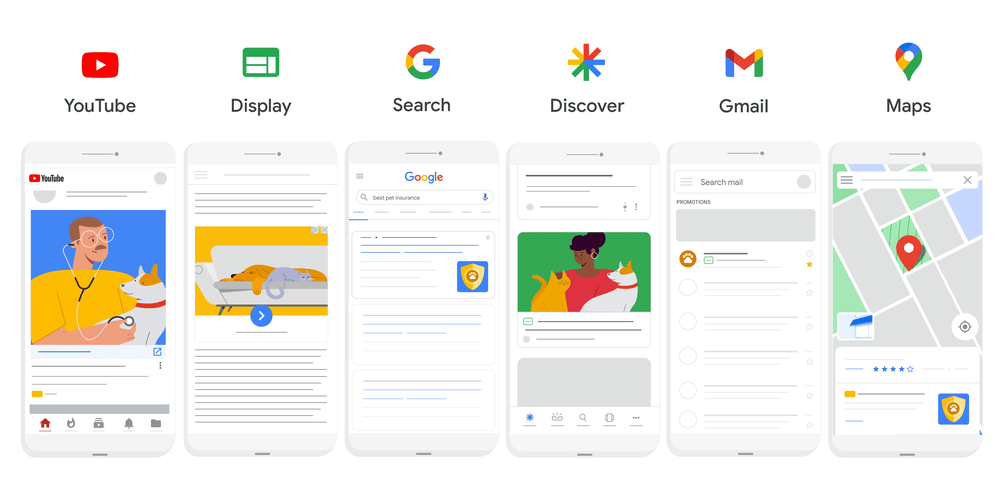
By choosing Performance Max campaigns, you ensure your ads appear across every Google interface, from classic search to YouTube, Gmail, Discover, the Display Network, and Google Shopping. Take advantage of the power and diversity of the Google ecosystem to connect with your customers wherever they are in their purchase journey.
Personalization Through Machine Learning Signals
Machine learning and audience signals are at the core of Performance Max campaigns for highly personalized ad delivery. This means delivering targeted, relevant, and compelling messages tailored to each user's specific needs. These campaigns are designed to give your customers unique experiences, thereby increasing your conversion rate and retention.
Conclusion
Google Ads is a powerful tool that offers a wide range of options for running your ads. Whether your priorities align with specific objectives, a defined budget, or a targeted audience, you have plenty to choose from with Search, Display, Video, App, Shopping, and Performance Max campaigns. Each campaign type has its own strengths and features, allowing you to fine-tune your advertising strategy. To maximize your visibility and results, you can even consider combining different campaign types.
To fully leverage the potential and diversity of Google Ads to promote your brand, products, or services, we recommend consulting a specialized paid search agency that can offer you tailored support.
Want support with your digital marketing strategy? Feel free to reach out!
FAQs
Q: What are the different types of advertising campaigns?
A: The different types of advertising campaigns are:
- Brand awareness campaign: aims to increase brand visibility with a broad audience.
- Brand image campaign: helps establish brand identity around specific values and differentiate from competitors.
- Promotional campaign: focuses on highlighting a product or service to drive purchases or trials.
- Product launch campaign: announces a new product to the market or an entirely new feature.
- Online and digital marketing campaign: leverages digital channels such as social media, search engines, or websites to reach users online.
Q: What are the different Google Ads formats?
A: Google Ads offers a variety of formats:
- Search network ads: text ads that appear in connection with users' keywords.
- Display ads: visual ads on Google partner sites and apps.
- Shopping ads: showcase products with direct links to retail sites.
- Video ads: videos served on YouTube or other partner placements.
- Remarketing ads: target internet users who have already visited your site or app.
- Gmail ads: appear as promotional messages in Gmail.
- App ads: designed to increase installs or usage of your app across Google platforms.
Q: What are Search Network campaigns used for?
A: Search Network campaigns allow you to run text ads on Google search results pages. They are effective for reaching users who are searching for specific products or services.
Q: How do you choose the most appropriate campaign type on Google Ads?
A: The choice of campaign type depends on your marketing objectives. For example, for brand awareness, Display or video campaigns are recommended, while for generating sales or leads, Search Network or Shopping campaigns are more effective.